On: August 24, 2026
Enroll in Aesthetic Training Programs for 2026
Licensed RNs, NPs, PAs, MDs/DOs, and dentists seeking 2026 aesthetic training find Coastal Aesthetic Training Institute’s small-class, evidence-based curriculum builds true competency. Programs combine cadaver-based anatomy workshops with real-model injection practice covering neuromodulators and dermal fillers. Expert-led mentorship prioritizes patient safety, precise technique, and natural outcomes, preparing professionals for confident, credentialed practice ahead of growing industry demand for skilled aesthetic injectors.
Key Takeaways
- Coastal Aesthetic Training Institute operates in Mystic, Connecticut, providing specialized medical aesthetic education programs.
- AMET trains five licensed healthcare professional types: RNs, NPs, PAs, MDs, DOs, and dentists.
- Empire Medical Training offers three distinct 2026 programs in Puerto Rico during July 30-31.
- Aesthetic training courses fulfill continuing medical education requirements for qualified healthcare professionals nationwide.
Why Are Clinicians Moving Into Medical Aesthetics?
Career opportunity drives the shift into medical aesthetics. The U.S. Bureau of Labor Statistics projects a notable share growth in demand for skin care specialists in the coming years, a pace that outstrips many traditional clinical roles. Patient demand for non-surgical procedures keeps climbing alongside that projection, and clinics need qualified injectors to keep pace.
For Advanced Practice Registered Nurses and Registered Nurses specifically, this shift offers something rare: professional autonomy paired with strong earning potential. You gain the ability to build a specialized practice, set your own hours in many settings, and step outside the constraints of hospital or primary care schedules.
Who Qualifies for Medical Aesthetics Training?
Eligibility extends to a defined group of licensed healthcare professionals. Registered nurses, nurse practitioners, physician assistants, physicians (MD or DO), and dentists (DDS or DMD) typically meet the requirements for aesthetic injector programs. If you hold one of these licenses, you already have the clinical foundation needed to add injectables to your scope of practice.
What’s Pulling Clinicians Away From Traditional Roles?
Three forces stand out:
- Growing patient demand for Botox, dermal fillers, and related treatments
- Career flexibility that traditional bedside or primary care roles rarely offer
- Long-term job security, backed by projected double-digit growth in the field
Momentum like this rewards clinicians who act early. When you enroll in aesthetic training programs now, you position yourself ahead of a field that’s only getting more competitive. And more lucrative for those with verified, hands-on skill.
What Makes a Training Program Truly Rigorous?
Rigor starts with evidence, not sales pitches. A quality curriculum teaches injection technique and anatomy grounded in clinical research rather than product marketing. Your decisions in the treatment room rest on data, not vendor promotions. When you enroll in aesthetic training programs built this way, you graduate with judgment that outlasts any single brand’s sales cycle.
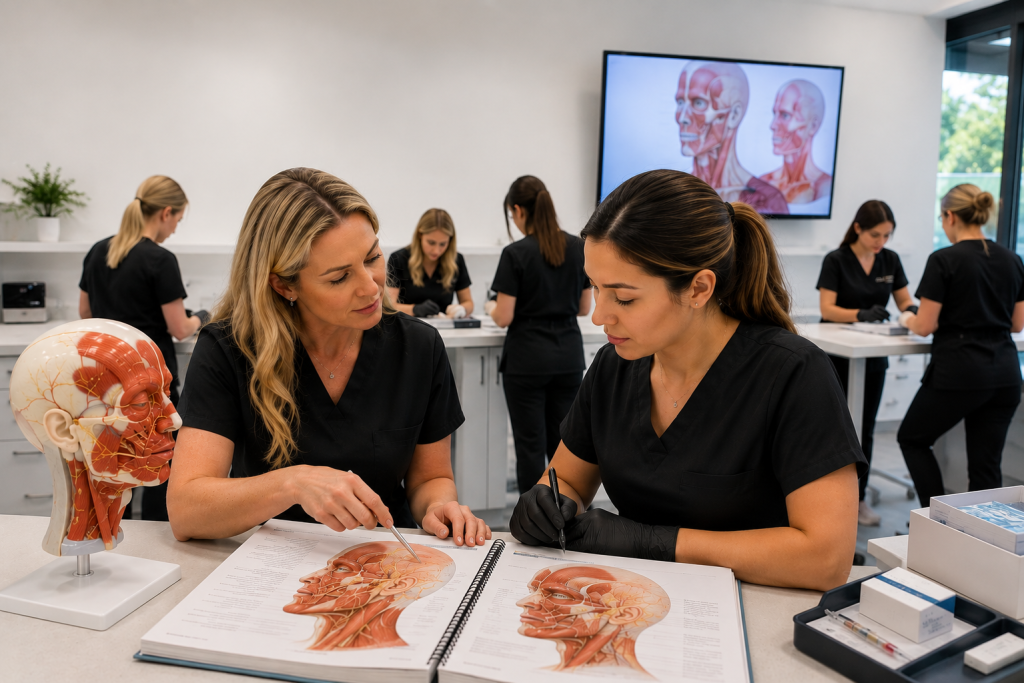
Anatomy mastery separates confident injectors from cautious ones. Diagrams and mannequins show you where structures sit. Cadaver specimens let you feel muscle layers, trace vascular pathways, and understand tissue depth firsthand. That tactile experience closes the gap between textbook knowledge and the unpredictable anatomy you encounter in real patients.
Why does cadaver-based training matter more than model-based courses?
Standard courses using models or simulations teach the basics, but they flatten anatomical variation into a single, simplified version. Human anatomy resists that simplification — vessels shift position, tissue density varies, and no two faces map identically. Cadaver work exposes those inconsistencies before you ever pick up a syringe on a live patient.
Does class size actually affect skill development?
Yes — significantly. Smaller classes mean more time at the table, more direct instructor correction, and fewer moments where you’re simply watching from the back of the room.
A rigorous program typically delivers:
- Evidence-based curriculum free of vendor influence
- Cadaver-based anatomy training for real tissue experience
- Small class sizes for individualized instructor feedback
- Hands-on repetition rather than passive observation
Before committing to any course, ask how it scores against these four pillars. Programs missing even one leave gaps in your clinical foundation — gaps your future patients will notice.
Which Techniques and Credentials Will You Master?
Neuromodulator injection technique and multi-product filler expertise anchor the curriculum, alongside anatomy-based safety protocols validated through hands-on practice. You gain skills built for real clinical demand, not generic theory. Skip proper training and you risk asymmetry, vascular complications, and results that damage your reputation before your practice gets off the ground.
Your coursework meets you wherever you stand professionally. Whether you’re an RN, PA, NP, or MD looking to sharpen foundational skills or push into advanced procedures, the training adapts to your starting point and career goals.
What fillers will you learn to inject?
You’ll train across multiple hyaluronic acid formulations, including Juvederm and Restylane, rather than mastering just one product line. Each filler behaves differently depending on viscosity, longevity, and placement depth, so understanding these distinctions directly shapes your ability to customize outcomes for facial harmony, volume restoration, or contouring goals.
This breadth matters because demand keeps expanding. An estimated large volume of soft tissue filler injections take place across the U.S. each year, with projections pointing upward. Patients expect injectors fluent in more than one product.
Will you learn Botox technique and theory?
Yes — you’ll study the pharmacology behind botulinum toxin, not just the injection motion. Coursework covers proper technique, dosing logic, and the muscle-targeting precision required for natural-looking results rather than frozen, artificial outcomes.
Here’s what your credential-building typically includes:
- Neuromodulator science and injection mechanics
- Multi-brand filler comparison and product selection
- Facial anatomy mapping for safer, more accurate placement
- Complication recognition and prevention protocols
Mastering these areas positions you to enroll in aesthetic training programs with confidence, knowing the skill set translates directly into safer patient outcomes and stronger clinical credibility.

How Do Cadaver Workshops Improve Injection Safety?
Cadaver-based training closes the distance between theory and real tissue, sharpening the precision that patient safety demands. Working on human specimens exposes you to facial structures, muscle layers, and vascular pathways exactly as they appear in practice—not as apartment diagrams suggest. That exposure builds an appreciation for anatomical variation, and variation is where guesswork causes complications.
You already know that precision, safety, and anatomical mastery have stopped being optional extras in aesthetic medicine. cite-1 They define competent practice. Cadaver dissection gives you a way to internalize that mastery before you ever pick up a syringe on a paying patient.
Why isn’t simulation-only training enough?
Simulated models teach injection mechanics, but they can’t replicate the texture, depth, or unpredictability of real vasculature. Hands-on dissection closes that gap by putting you in direct contact with authentic anatomical structures. You feel resistance, locate vessels by touch, and register how tissue planes actually separate—details no synthetic model fully reproduces.
What does a cadaver workshop actually build in a practitioner?
Confidence and accuracy, at every career stage. If you’re deciding whether to enroll in aesthetic training programs that include cadaver labs, weigh what each format delivers:
For RNs, NPs, PAs, MDs, DOs, and dentists expanding into injectables, this distinction matters. Skipping direct anatomical exposure leaves you reliant on assumption rather than verified structure—an unacceptable trade-off when a single misplaced injection carries real vascular risk. Choose training that puts real anatomy in your hands before it’s in your patient’s face.
How Do You Enroll and Keep Skills Sharp?
Enrollment starts with a straightforward step: contact Coastal Aesthetic Training Institute directly to review course options and confirm licensure eligibility. Skipping proper vetting costs you more than tuition. It costs you clinical confidence when a real patient sits in your chair. Enrolling in aesthetic training programs built on structured mentorship protects both your license and your outcomes.
Coastal Aesthetic Training Institute operates out of Mystic, Connecticut, giving healthcare professionals across the region a dedicated home base for hands-on education. You won’t find a generic seminar model here. Instead, coursework moves from foundational anatomy and injection theory into advanced procedural techniques, cadaver-based workshops, and real-model injection sessions.
What Does the Course Path Look Like?
Your training path typically progresses in stages, not a single one-off class:
- Foundational learning — core anatomy, safety protocols, and injectable science.
- Advanced procedural techniques — complex filler and neuromodulator applications.
- Cadaver workshops — direct anatomical study for precision and risk reduction.
- Real-model injections — supervised practice on live models before independent work.
Does Training Stop After Enrollment?
No — skill-building continues well past your initial course completion. Coastal Aesthetic Training Institute provides ongoing support and refresher courses, helping you keep pace as techniques, products, and safety standards evolve. Aesthetic medicine shifts quickly; a technique considered best practice two years ago may already carry more risk today.
Many programs in medical aesthetics also count toward continuing medical education requirements for qualified professionals. That means your enrollment does double duty: sharpening technique while supporting the credentialing your license demands. Choosing a program with built-in refreshers isn’t optional maintenance — it’s how you stay competitive and keep patients safe.
FAQ
Who qualifies for aesthetic training programs?
Licensed RNs, NPs, PAs, MDs/DOs, and dentists (DDS or DMD) meet the requirements for aesthetic injector programs at Coastal Aesthetic Training Institute.
What does Coastal Aesthetic Training Institute’s curriculum include?
The program combines cadaver-based anatomy workshops with real-model injection practice covering neuromodulators. Dermal fillers, guided by expert-led mentorship focused on safety and technique.
Where is Coastal Aesthetic Training Institute located?
Coastal Aesthetic Training Institute operates in Mystic, Connecticut, providing specialized medical aesthetic education programs for licensed healthcare professionals.