
On: August 3, 2026
Aesthetic Practitioner Career Opportunities for MDs
Licensed RNs, NPs, PAs, and MDs expand clinical practice into medical aesthetics through injector training, with skin care specialist demand projected to grow significantly in the coming years, per the U.S. Bureau of Labor Statistics. Coastal Aesthetic Training Institute prepares you for injector, medical director, and nurse injector roles through hands-on cadaver-based training and precise injection technique instruction.
The Professional Outlook in Medical Aesthetics
- Medical aesthetics employs dermatologists, plastic surgeons, nurse practitioners, physician assistants, and registered nurses specializing in aesthetic treatments.
- Coastal Aesthetic Training Institute in Mystic, CT trains professionals for careers in the medical aesthetics industry.
- Aesthetic practitioner positions offer benefits including health insurance, 401(k) plans, paid time off, and employee discounts.
- Advanced Practice Registered Nurses work as 1099 contractors administering injectables, chemical peels, and facial treatments in med spas.
Why Are Clinicians Exploring Aesthetic Medicine Now?
Federal labor data explains most of the shift. The U.S. Bureau of Labor Statistics projects significant growth in demand for skin care specialists in the coming years, a rate that signals lasting stability rather than a passing trend. For an RN, NP, PA, or MD weighing a pivot, that kind of trajectory matters more than a flashy job posting ever could.
Staying in a single clinical lane also means missing out on where the field is actually expanding. Aesthetic practitioner career opportunities now stretch far beyond the injector chair. The industry employs aesthetic physicians, including dermatologists and plastic surgeons, alongside nurse practitioners, physician assistants, registered nurses, medical estheticians, laser technicians, and practice managers who run day-to-day clinical operations.
What’s driving patient demand for these treatments?
Neuromodulator treatments deserve credit here. Botox earned FDA approval for cosmetic use. Since then it has become one of the most requested procedures in aesthetic medicine. That approval opened a clinical demand curve that keeps widening every year.
Is this just for injectors, or are there other paths?
No — the pathways vary widely depending on your license and interests:
- Direct injectors: RNs, NPs, PAs, and physicians administering Botox and filler treatments
- Clinical leadership: Medical directors overseeing safety protocols and treatment standards
- Practice operations: Managers coordinating scheduling, compliance, and patient flow
- Specialized technical roles: Laser technicians and medical estheticians handling adjunct procedures
You don’t need to abandon your current license to explore this field. You need the right anatomical foundation and injection training to translate existing clinical judgment into aesthetic outcomes patients trust.

Which Aesthetic Roles Match Your Medical License?
Your medical license determines which injectable procedures you can legally perform and how far your aesthetic career advances. Guessing wrong wastes months of training on services your credential doesn’t authorize. That’s true whether you’re building an aesthetic nurse practitioner career or expanding an MD-level practice.
Registered nurses, nurse practitioners, and physician assistants who work as aesthetic nurse injectors handle the complete clinical arc of injectable care. That scope covers the initial consultation, treatment planning, the injection itself, complication management, and post-treatment follow-up. Few other aesthetic practitioner career opportunities demand this much clinical judgment from first visit to last.
Scope of practice varies sharply by credential:
Can Every Medical Professional Perform Injectable Treatments?
No. Medical estheticians cannot legally perform injectable treatments, regardless of experience. Their role stays limited to non-invasive services like facials, peels, and microdermabrasion. Injecting Botox or dermal filler requires a nursing, physician assistant, nurse practitioner, or physician license.
If you already hold an RN, PA, NP, or MD license, your ceiling is higher than you might assume. With anatomy-based training built around real tissue, clinicians at every one of those levels advance into more complex injectable procedures, not just basic touch-ups.
What Career Paths Exist Beyond Injecting?
Injecting isn’t the only ladder in this field. Medical directors oversee clinical operations across an entire aesthetic practice, setting protocols and supervising injectors. That path suits licensed professionals who want to combine hands-on skill with practice leadership.
What Training Builds True Injection Confidence?
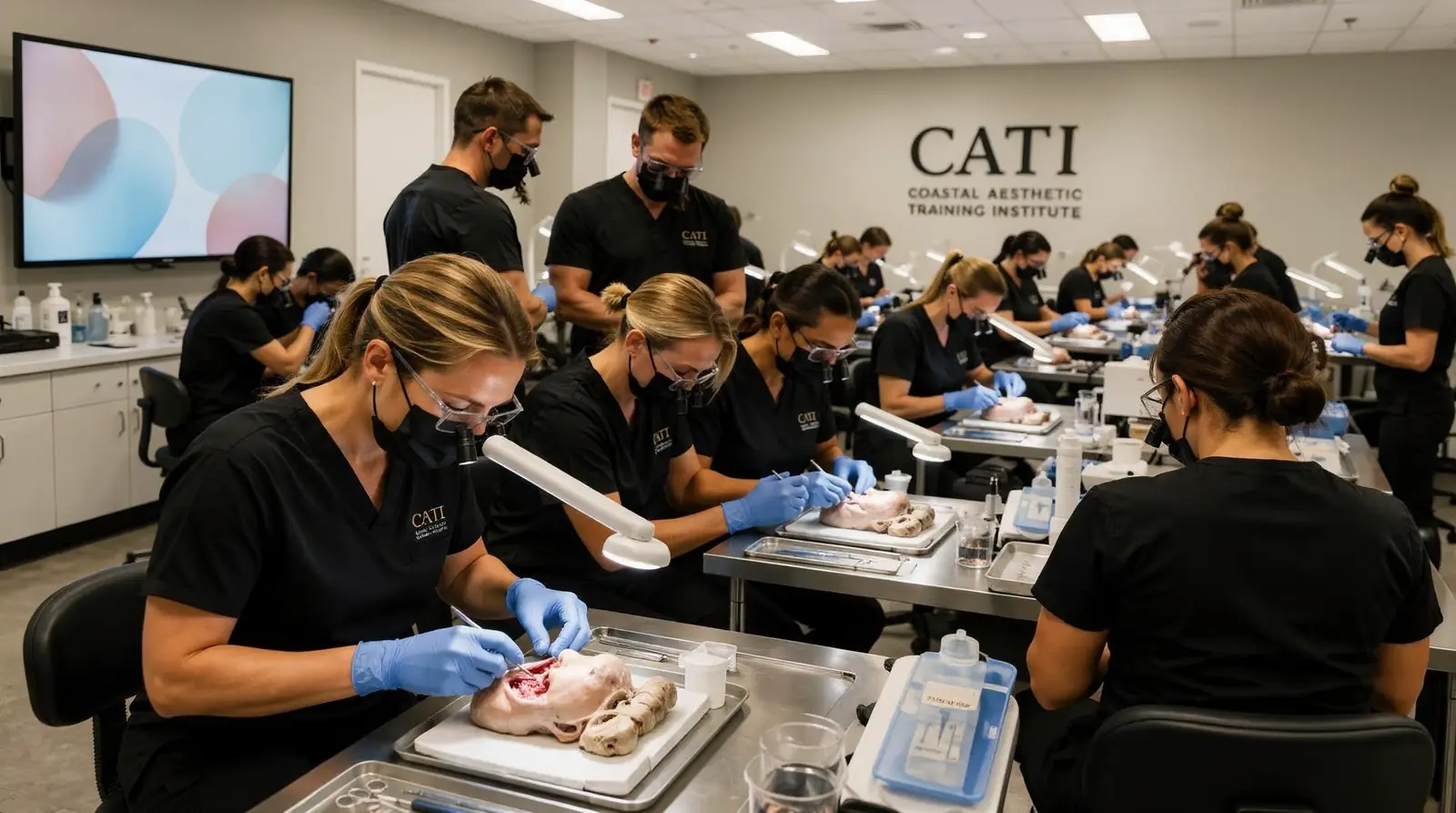
Real injection confidence comes from touching actual human tissue, not from practicing on synthetic models. Cadaver-based dissection exposes the vascular pathways, muscle layers, and facial planes that diagrams and mannequins simply cannot reproduce. For a practicing RN, NP, PA, or physician weighing new aesthetic practitioner career opportunities, this distinction determines whether you walk into a treatment room prepared or guessing.
Working directly with cadaver specimens changes how you understand the face. You see where nerves branch, how muscle layers interact, and where major vessels run before you ever pick up a needle on a live patient. That firsthand exposure closes the gap between textbook anatomy and clinical reality.
Cadaver-based workshops sharpen precision at every career stage. Whether you’re transitioning from bedside nursing or expanding an existing aesthetic practice, this format builds accuracy alongside confidence.
Why does hands-on cadaver training matter more than model-based courses?
Models flatten anatomy into a single, predictable shape. Real tissue varies patient to patient, which is exactly what you’ll face in practice. Cadaver work trains your eye and hand for that variability before a client ever sits in your chair.
Does instructor credentialing affect training quality?
Yes. Learning under board-certified plastic surgeons and Platinum-level injector trainers adds a layer of clinical authority that generic courses lack. cite-1 That credentialed leadership means the anatomy lessons and injection protocols reflect years of surgical and aesthetic practice, not just classroom theory.
Choose training that puts real anatomy in front of you, not approximations of it.
What Does the Aesthetic Job Market Offer?
Growth defines the current aesthetic job market. The U.S. Bureau of Labor Statistics projects demand for skin care specialists to rise significantly in the coming years, a pace that signals sustained hiring across med spas, dermatology practices, and cosmetic clinics — and a growing pool of medical aesthetics jobs for nurses at every experience level. For licensed clinicians weighing aesthetic practitioner career opportunities, that trajectory matters. It means the specialty isn’t a short-lived trend; it’s a durable pivot point for your career.
Compensation structures vary, but many employers build in real financial stability. Med spas frequently advertise health insurance, 401(k) contributions, paid time off, and employee discounts as standard benefits. Some sweeten the deal further with referral bonuses tied to client acquisition.
Can you work in aesthetics as an independent contractor?
Yes. Concierge med spa models often hire advanced practice nurses as 1099 contractors, giving you control over your schedule and client roster. You set your hours, choose your patients, and deliver services like neuromodulator injections, chemical peels, and at-home facials without being tied to a traditional clinic shift.
Do aesthetic employers support ongoing skill development?
Established medical spas typically pair full-time benefits with regular continuing education access. This combination lets you build income now while sharpening technique over time.
Your options generally fall into two tracks:
- Employed roles — Full-time positions with health coverage, retirement matching, paid time off, and structured education support.
- Contractor roles — Flexible 1099 arrangements offering schedule autonomy and direct client relationships, particularly for APRNs entering aesthetics.
Neither path requires abandoning your clinical foundation. Both let you apply it in a growing, benefit-rich specialty.
How Do You Start Your Aesthetic Career Transition?
Clinical experience alone doesn’t prepare a nurse, PA, or physician for injectable practice. Aesthetic practitioner career opportunities open up fastest through structured aesthetic injector training that builds anatomical confidence before you touch a live patient, laying the groundwork for smoothly transitioning to aesthetic medicine. Start with a foundational Botox program that covers the science behind neuromodulators, correct injection technique, and how to produce natural-looking results rather than overcorrected ones.
From there, progress into cadaver-based training. These workshops are built for medical professionals at every career stage, including clinicians pivoting from emergency medicine, primary care, or dentistry into aesthetics. Working on real anatomy—vessels, nerves, muscle layers—closes the gap between textbook knowledge and confident needle placement.
What credentials do you need to switch into medical aesthetics?
Your existing license as an RN, NP, PA, or MD/DO already qualifies you to inject. The missing piece is procedural training and anatomical mastery, not a new degree. Focused coursework in injectables and cadaver dissection fills that gap efficiently. For RNs specifically asking how to become an aesthetic nurse, that same coursework — foundational injectable training followed by cadaver-based practice — is the direct path in.
Where should Northeast clinicians train?
Coastal Aesthetic Training Institute operates out of Mystic, Connecticut, giving clinicians across the Northeast a regional base for hands-on education instead of traveling out of state.
A realistic transition path looks like this:
- Complete foundational injectable training in neuromodulators and technique.
- Attend a cadaver workshop to reinforce vascular and muscular anatomy.
- Use ongoing refresher courses to stay current as techniques and safety standards evolve.
Skipping any step raises your risk of complications and slows your path to a confident, independent practice.
Aesthetic medicine offers a real career trajectory for medical professionals ready to expand their clinical expertise and patient impact. Rigorous, evidence-based training through institutions like Coastal Aesthetic Training Institute in Mystic, Connecticut builds the technical proficiency and anatomical mastery you need to deliver consistent, exceptional results. That training strengthens your professional credibility and puts you at the forefront of a field where precision, safety, and artistry come together to shape patient outcomes and practice growth.
FAQ
Why are clinicians exploring aesthetic medicine now?
The U.S. Bureau of Labor Statistics projects significant growth in demand for skin care specialists in the coming years. Coastal Aesthetic Training Institute in Mystic, CT trains RNs, NPs, PAs, and MDs for injector, medical director, and nurse injector roles.
What career paths exist beyond becoming an injector?
Medical aesthetics offers clinical leadership as a medical director, practice operations management, and specialized technical roles like laser technician or medical esthetician. Direct injecting remains one option among several paths for licensed professionals.
What does an aesthetic nurse injector role involve?
Aesthetic nurse injectors handle the complete clinical arc of injectable care, including initial consultation, treatment planning, the injection itself, and complication management. RNs, NPs, and PAs perform this work within their license scope.